Loading…
Feature Preview
The Orchestration Library —
A Complete Reference for Composers.
A composer who doesn’t know the instruments is guessing. Range, timbre, register, idiomatic writing, extended techniques — everything you need to write for real players, not hypothetical ones. Here is the actual reference page for the violin.
The Orchestration Library — the violin reference page
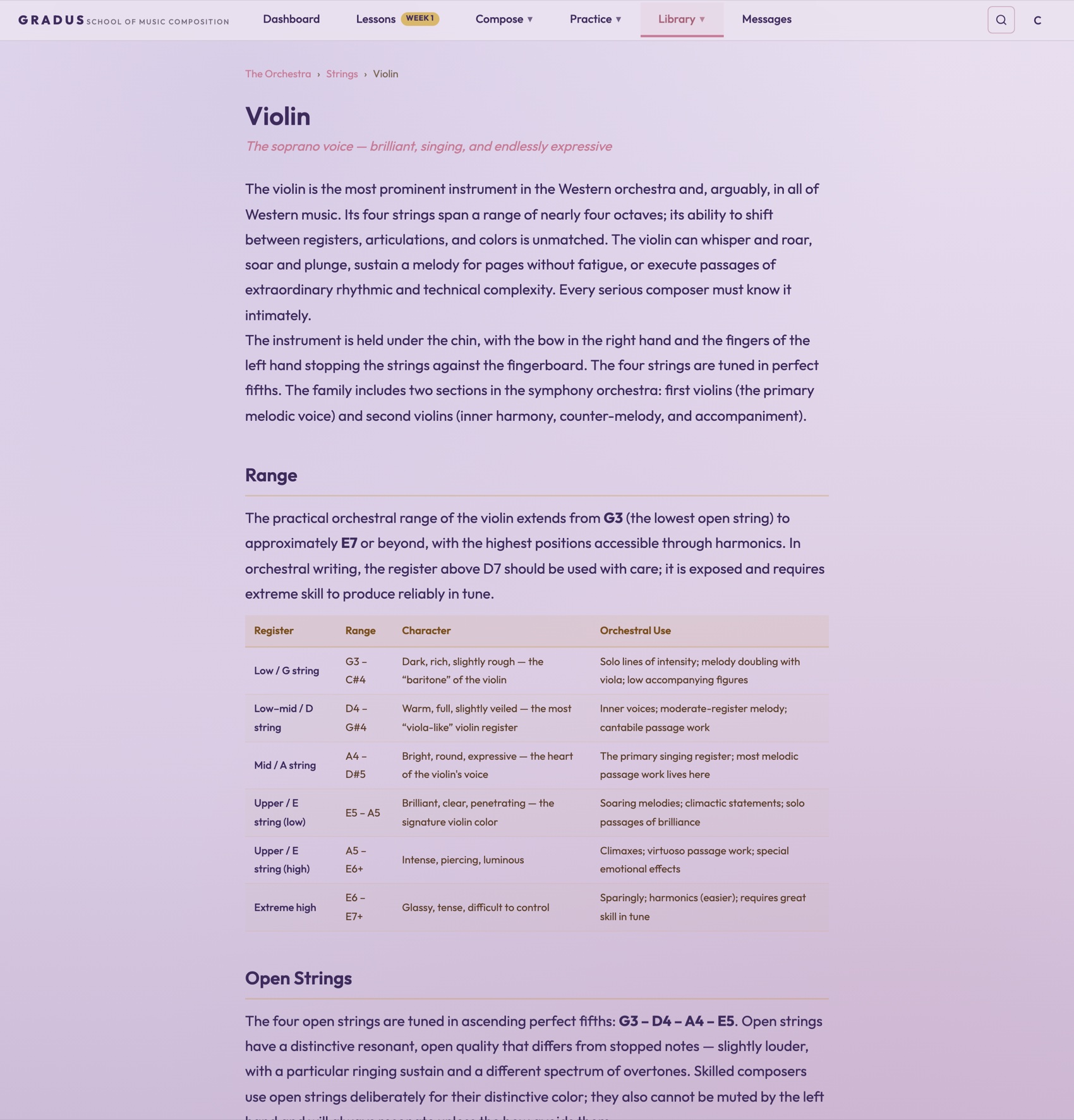
One page of the reference — and every instrument has one this deep: range, register-by-register character, extended techniques, repertoire, and historical context.
What’s in the Library
Complete Instrument Coverage
Strings, woodwinds, brass, and percussion — each with detailed range charts, register descriptions, and idiomatic writing guidelines.
Harmonics & Extended Techniques
Natural and artificial harmonics, col legno, sul ponticello, flutter-tongue, multiphonics — every technique explained practically for the composer.
Repertoire References
Each technique links to a specific passage in the standard repertoire. Not abstract theory — Mahler's horn writing, Ravel's string harmonics.
Orchestral Balance Guide
Dynamic equivalence tables: how many flutes balance a trumpet? How does register affect projection? The reference every scorer needs before writing the first note.
Historical Context
When each instrument joined the orchestra, how it evolved, and how composers from Monteverdi to Messiaen used it differently — giving historical perspective to modern choices.
Era-by-Era Texture Analysis
From Renaissance consort to modern orchestra — see how the ensemble changed across centuries and how each era's problems shaped the writing.
And every way they combine
Knowing the instruments is half of it. The library also documents over 500 instrument combinations — which blends work, which fight, and why — each with a timbre description, balance notes, best register, and a passage from the repertoire that uses it.
Strings 85Woodwinds 74Brass 72Cross-family 184Special effects 68Tutti 36519 total
The complete orchestration reference you keep open while scoring.
Included with every Gradus subscription.